Audi postpones power unit upgrade to 2027
Plus: Lawson awaits seat clarity, Haas acknowledges resource gap, and Mercedes reveals strategic upgrade timing.
TL;DR
- Audi defers major engine work to 2027, focusing current efforts on driveability and baseline stability under cost cap pressure.
- Liam Lawson expects Racing Bulls to discuss his 2027 seat during the summer break, with three drivers competing for two spots.
- Haas principal Ayao Komatsu attributed the team's development slide to workforce size and resources, not capability.
- Mercedes revealed it deliberately weighted upgrades toward the second half of 2026 rather than front-loading the season.
Team and driver news
Lawson, Sainz, and Haas address F1's midseason reckoning
As the summer break takes hold, seats, resources, and career trajectories all came into sharp focus.

Liam Lawson expects Racing Bulls to discuss his 2027 future during the summer shutdown. The New Zealand driver, who has scored 43 points through 11 rounds, told Autosport that "that conversation is normally around summer break" and he "actually has no idea" what lies ahead. Red Bull faces complexity with three promising drivers—Lawson, Nikola Tsolov, and Arvid Lindblad—competing for two Racing Bulls seats, with boss Alan Permane confirming Tsolov is "next in line." (via RacingNews365)
Carlos Sainz faces career juncture at Williams. Sky F1's Martin Brundle described Sainz as "down a cul-de-sac" at a critical juncture, noting that the Williams driver is "stalling out at a time in his career and life that is not optimal." With Williams ninth in the constructors' championship on 11 points, Sainz asked his management to keep him out of the driver market discussion until after the summer break, though Brundle suggested he is "probably keeping his options open." (via PlanetF1)
Haas principal takes blame for development lag. Ayao Komatsu acknowledged that Haas's recent performance slide stems from resource limitations rather than capability. "The fact that we fell behind in the development race is definitely not a reflection of their capability," he said, pointing to Haas's ~400-person workforce—the grid's smallest—as a constraint that larger teams have exploited as the 2026 season progressed. (via RacingNews365)
Esteban Ocon reflects on emotional 2019 sidelines year. In an Autosport interview, Ocon opened up about his time as a Mercedes reserve in 2019, when contractual complications left him benched despite strong performance the previous season. "I went back to the rental car and I cried, because for me driving was going to be super important," he said, describing a year of simulator work and waiting months for scheduled track testing while watching Mercedes dominate races. (via Motorsport.com)
Technical and regulations
Engine delays and upgrade calculus reshape F1's performance chase
With major development decisions now locked in for months, teams are gambling on when to deploy their remaining advantages.
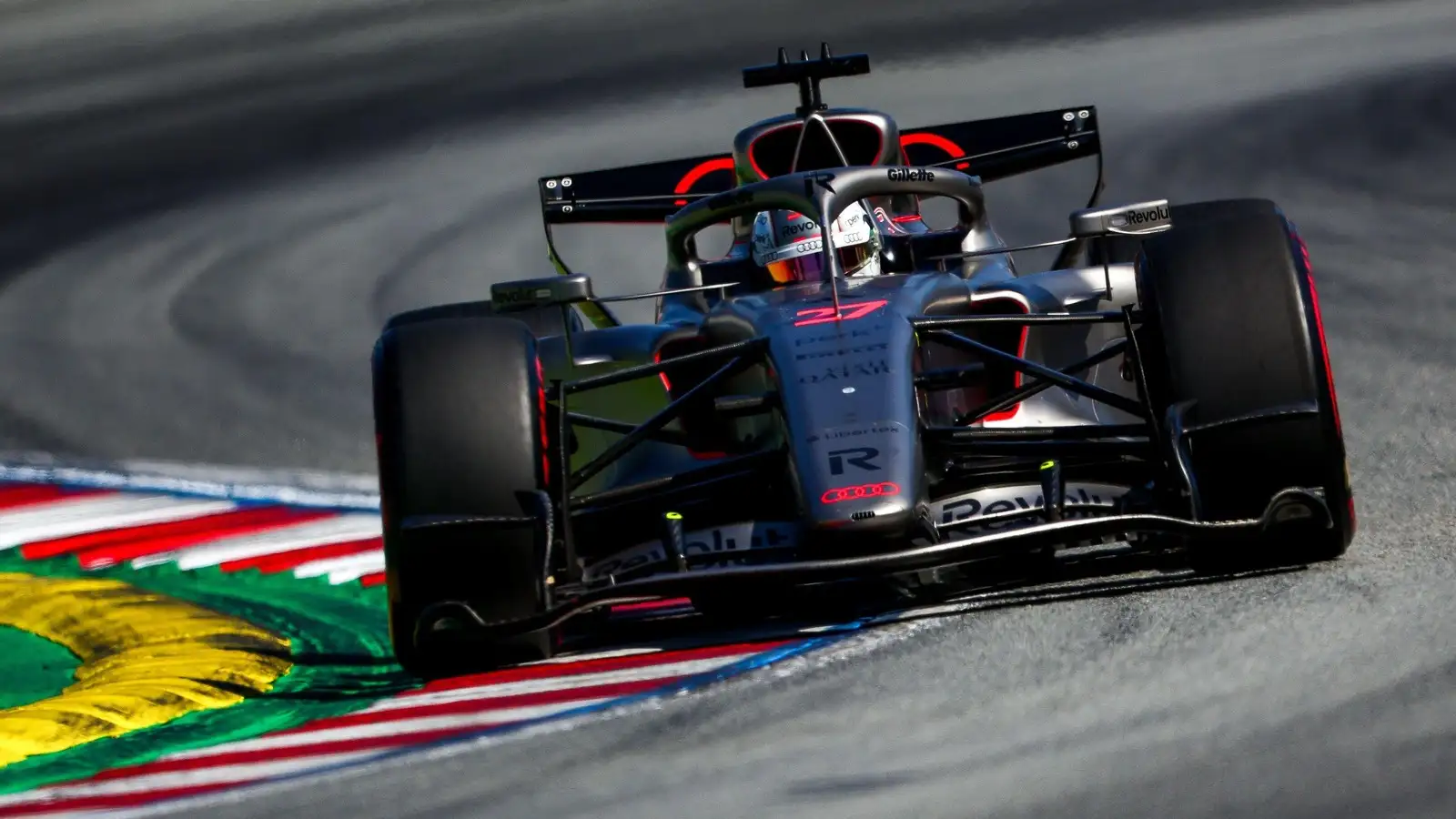
Audi has postponed its second power unit upgrade until 2027, conceding that budget cap constraints and the need for a stable performance baseline take priority over this season. Team principal Allan McNish explained: "the bigger parts are for 2027. So we will not see anything big on the power unit until then." Audi already used one development token at Barcelona on driveability improvements; the power unit currently trails competitors by roughly one second per lap, with the internal combustion engine performing approximately four percent below the Red Bull Powertrains benchmark. (via PlanetF1)
McLaren rejects Mercedes' multifactorial upgrade theory. In a direct rebuttal, McLaren team principal Andrea Stella disputed Mercedes deputy technical director Simone Resta's suggestion that factors beyond the technical package explained their Hungarian dominance. Stella stated: "The improvement, from a competitiveness point of view, can be entirely ascribed to the upgrades that we took here, which included several items"—a revised floor, rear wing endplate, and rear corner winglets. The gap between the two teams' analyses underscores the opacity surrounding upgrade impact during a season where nearly every team has deployed significant packages. (via PlanetF1)
Mercedes reveals strategic upgrade hold. Toto Wolff confirmed Mercedes deliberately weighted its W17 package toward the second half of the season rather than front-loading development. "We just need to be really strategic about when to bring the upgrades," he said. Mercedes has already deployed a major update worth approximately 0.3 seconds per lap at Canada, featuring a redesigned front wing, revised suspension, updated floor, and lighter gearbox, but is holding back additional components while "running hard on updates in the tunnel." (via RacingNews365)
Aston Martin's upgrade delivers incremental gains. Former Ferrari engineer Rob Smedley's analysis of exclusive performance data from Aston Martin's 16-part Hungarian upgrade package showed the team narrowed its qualifying deficit to pole position from 4.1 percent to 3.9 percent. Smedley found that Fernando Alonso's upgraded AMR26 exhibited superior downforce and stability in minimum corner speeds compared to Carlos Sainz's Williams, though Sainz's engine advantage meant the Williams reached up to 10 km/h faster on straights. The data confirmed Aston Martin had surpassed Cadillac and Williams but "has not yet" moved ahead of Haas. (via PlanetF1)