TL;DR
- Carney and the premiers left their Charlottetown meeting united against Trump's new 50 percent tariffs, with the prime minister saying "everything is on the table" if no deal lands next month.
- The Bank of Canada held its key rate at 2.25 percent for a sixth straight meeting even as inflation hit 3.2 percent and the Canadian dollar sagged near 71 cents US.
- Ottawa is weighing whether to take direct equity stakes in Canadian AI startups through a new $500-million growth fund, a break from its usual loans and grants.
- More than 830 wildfires are burning nationwide and record rain has swamped Manitoba's Parkland region, with over 30 communities under states of emergency.
Politics and policy
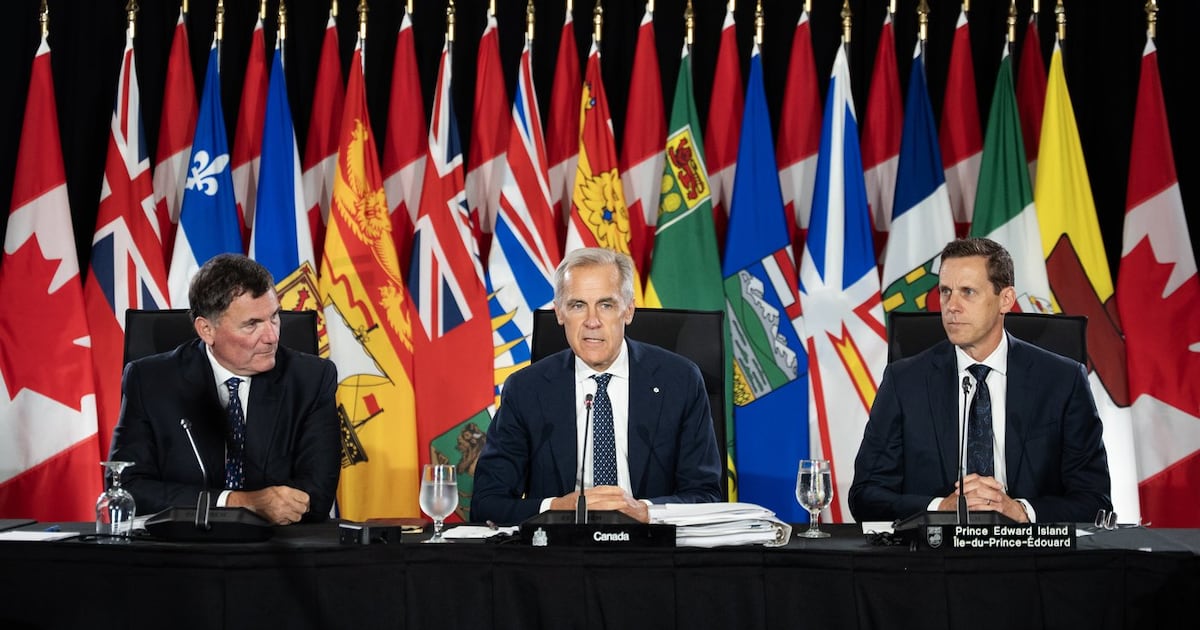
Canada's premiers closed ranks behind Prime Minister Mark Carney this week after U.S. President Donald Trump signed orders to raise tariffs by 50 percent on a range of Canadian goods, from hockey sticks to honey to cement. Wrapping up a First Ministers' Meeting in Charlottetown on July 23, 2026, Carney said Canada is in a stronger position than when the trade war began 18 months ago and that "everything is on the table" if no agreement is reached before the new duties bite next month. Ontario's Doug Ford struck the same note ("We're a strong country. We're a sovereign country"), while Alberta's Danielle Smith said Canada has a narrow window to sharpen its pitch on renewing the Canada-United States-Mexico Agreement (via BNN Bloomberg).
Behind the show of unity, the leaders also tried to tariff-proof the economy from within. The first ministers agreed to work toward an agreement-in-principle to knock down interprovincial trade barriers, the long-standing rules that make it harder to sell goods and move workers across provincial lines, and pushed ahead on a federal electricity strategy meant to tie provincial grids together (via Prime Minister of Canada). Not everyone left convinced a deal with Washington is close, but the premiers said they are backing Carney's negotiators as the talks drag on (via CBC News).
Business and economy
The Bank of Canada is holding its nerve, and its rate. On July 15, 2026, the central bank left its benchmark overnight rate at 2.25 percent for a sixth straight meeting, even as inflation climbed to 3.2 percent in May, well above the 2 percent target it aims for. The culprit is largely gasoline, pushed up by a war in the Middle East, and the same forces have dragged the loonie down to around 71 cents US, which makes everything Canada imports pricier. The bank expects inflation to ease back toward 2 percent by early 2027, but for now borrowers hoping for cheaper mortgages are still waiting (via Bank of Canada).
Canada's housing market is finally showing a pulse after a long slide. Home sales rose for a third straight month in June, up a seasonally adjusted 0.5 percent, and the national benchmark price held essentially flat at about $657,700, the first month without a decline in 17 months, the Canadian Real Estate Association reported. Even condominiums, the weakest corner of the market, posted their first monthly price gain in nearly three years. It is stabilization, not a boom: sales are still running roughly 11 percent below their 10-year average (via CBC News).
Technology and industry

Ottawa may be about to start picking winners in artificial intelligence, cheque in hand. AI Minister Evan Solomon says the federal government is weighing whether to become a lead investor in Canadian AI companies through a new $500-million Canadian Tech Growth Fund, taking direct equity stakes rather than the loans and grants it has traditionally handed out. "There's often a lack of a lead investor, we could play that role," Solomon said, framing government money as a way to draw in private venture capital and keep promising startups from scaling abroad. Critics, including the Council of Canadian Innovators, warn there is still little detail on how the equity mechanism would actually work (via BetaKit).
The intervention comes as the money for young Canadian companies keeps drying up. Early-stage startup funding has been in a sustained decline since the start of 2025, according to a report from RBCx, the tech arm of Royal Bank of Canada. In the first quarter of 2026, just 61 startups raised close to $190 million combined, a roughly 40 percent drop from the same period a year earlier. The scale-up gap that Ottawa's new fund is meant to plug, in other words, is widening (via BetaKit).
Society
Canada is deep into another brutal fire season. More than 830 wildfires were burning across the country in mid-July, with roughly 1.81 million hectares already lost and forecasts of intense heat and low rainfall pointing to more trouble ahead. The fires have forced fresh evacuations in First Nations communities, following three years of historic destruction (via CBC News).
While the West burns, Manitoba is drowning. Up to 200 millimetres of rain hammered the Parkland region, washing out as many as 50 roads and swamping communities like Dauphin and Swan River, with more than 30 municipalities and First Nations declaring states of emergency. Premier Wab Kinew urged residents to stay off the highways, and Minegoziibe Anishinabe First Nation declared its own emergency over washed-out infrastructure (via CBC News).
Public health officials in the Toronto area are chasing measles again. Peel Public Health warned of possible exposure at Pearson airport and on two flights on July 7, part of a run of alerts as travel-linked cases tick up. Toronto Public Health says the city has confirmed several measles cases tied to travel outside Canada so far this year, all against a backdrop of rising cases in many countries (via CBC News).