TL;DR
- Soyuz MS-28 crew landed safely in Kazakhstan after 241 days on the ISS, completing Expedition 74.
- Astronomers confirmed the first atmosphere on a rocky exoplanet in another star's habitable zone, a major step in the search for potentially habitable worlds.
- Underwater oxygen loss is disrupting ecosystems and climate regulation at an alarming rate, scientists warn.
- The Space Force tripled its spending ceiling for national security space launches through 2029.
Launches and missions
Crew returns safely, lightning-struck rocket reaches orbit
A NASA astronaut and two Russian cosmonauts completed eight months in orbit while a Chinese rocket delivered its payload despite a dramatic electrical strike.
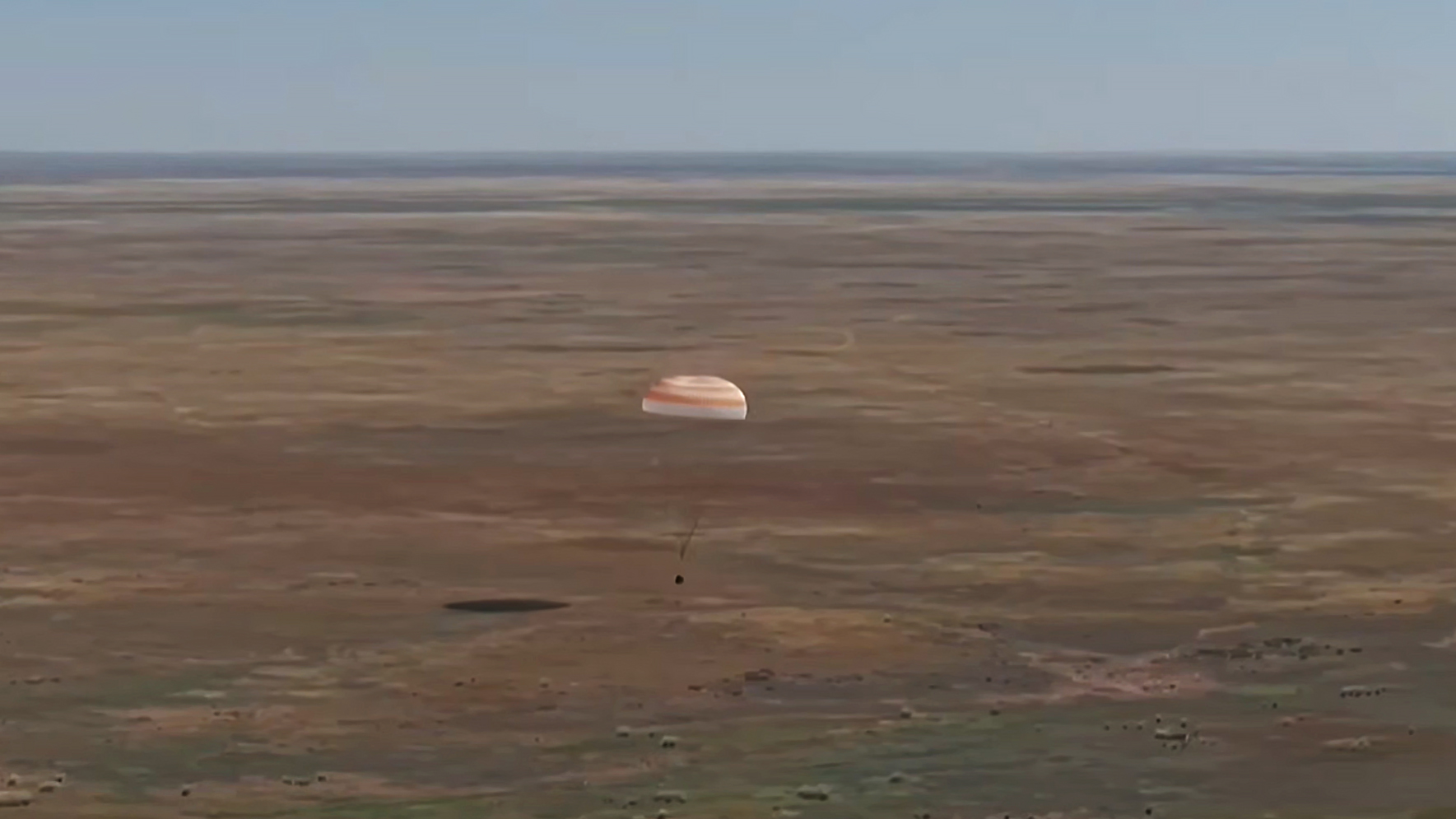
NASA astronaut Chris Williams and Roscosmos cosmonauts Sergey Kud-Sverchkov and Sergei Mikaev touched down in Kazakhstan at 5:27 a.m. CDT, wrapping up a 241-day mission aboard the International Space Station. The Soyuz MS-28 crew orbited Earth 3,856 times, traveling over 102 million miles before parachuting to a safe landing on the Kazakh steppe. This marked the first flight for Williams and Mikaev. (via NASA)
Lightning strikes Chinese rocket but mission succeeds. A Long March 3B rocket lifted off into stormy skies from Xichang on July 23 and was struck by lightning roughly 30 seconds into flight. Photographer Zhou Quan's dramatic image of the strike went viral, but the Tianlian-2 relay satellite reached geostationary transfer orbit as planned. China Aerospace Science and Technology Corporation declared complete success despite never mentioning the lightning event. (via SpaceNews)
Artemis II pilot urges NASA to reconsider lunar strategy. Victor Glover, piloting the upcoming Artemis II mission, argues that initial moon landings should target the equatorial regions rather than the hazardous south pole. Glover cited predictable sunlight, simpler orbital dynamics, and stronger communication as advantages of equatorial sites. Equatorial landings could provide a more manageable stepping stone before tackling the south pole's extremes. (via Space.com)
Space science
First atmosphere detected on distant rocky world
Astronomers confirmed an atmosphere around a rocky exoplanet in another star's habitable zone, marking a major milestone in detecting potentially life-supporting worlds beyond our solar system.
Astronomers detected the first confirmed atmosphere around a rocky planet orbiting within its star's habitable zone, where liquid water could exist on the surface. LHS 1140 b, located roughly 48 light-years from Earth, circles a red dwarf in the constellation Cetus with a helium-dominated upper atmosphere slowly leaking into space. The discovery, published in Science, offers the strongest evidence yet that Earth-like rocky planets can retain atmospheres in regions temperate enough to support life. (via Space.com)
Sun's 11-year cycle shows predictable turning point. Researchers identified a newly discovered phase in the sun's magnetic cycle that could allow scientists to predict future solar activity years earlier than current methods permit. The turning point, linked to changes in how solar magnetic fields reorganize, offers a measurable marker for forecasting the intensity of upcoming solar storms and auroras. This advancement could improve space weather prediction accuracy significantly. (via Phys.org)
Dark comet reveals dual nature. Astronomers discovered what appeared to be a normal asteroid actually behaves like a comet, displaying both solid rock and icy-outgassing properties simultaneously. The unusual object challenges conventional asteroid-comet classification, suggesting a larger population of hybrid bodies exists in the solar system with properties spanning both categories. (via Space.com)
Research and discovery
Twisted light identifies molecules, AI enhances medical imaging
Researchers use polarized laser light to distinguish mirror-image molecules while physics-based machine learning dramatically improves biomedical imaging through silicon cameras.

Scientists used twisted laser light to distinguish mirror-image molecules by analyzing their fragmentation patterns. The technique, exploiting the orbital angular momentum of structured light, separates left and right-handed molecular twins that behave differently in biological systems. The method could accelerate drug discovery and enable faster analysis of chiral molecules critical to pharmaceutical development. (via Phys.org)
Physics-informed AI reshapes complex-media imaging. A new machine learning framework called DeepTimeGate uses physics constraints to enhance biomedical imaging with low-cost silicon cameras, more than doubling signal-to-noise ratio and enabling near real-time reconstruction. The approach combines conventional cameras with algorithmic intelligence, potentially democratizing advanced imaging by eliminating specialized hardware. (via Phys.org)
Trace molecules emerge as ecosystem architects. A new study in Trends in Ecology & Evolution identified trace molecules as chemical "keystones" that govern microbial communities and ecosystem functioning. These minor chemical species, often overlooked in ecological models, steer the composition and behavior of entire microbial consortia. Researchers now recognize trace molecules as pivotal regulators of biogeochemical cycles and ecosystem stability. (via Phys.org)
Industry and policy
Pentagon triples launch spending cap, Artemis Accords expand
The Space Force dramatically increased its national security launch budget while two more nations joined the international moon exploration accord, bringing signatories to 70.

The U.S. Space Force raised the maximum value of its National Security Space Launch Phase 3 Lane 1 contract from $5.6 billion to $17 billion through fiscal year 2029. The tripling reflects surging military satellite launches and expanded competition among seven companies for launch task orders. The increase signals government confidence in commercial spaceflight's capacity to meet national defense needs. (via SpaceNews)
Two more nations sign Artemis moon exploration accord. Serbia and Mauritius joined the Artemis Accords this week, bringing total signatories to 70 countries and expanding international commitment to peaceful lunar exploration. The accord establishes principles for space exploration safety, sustainability, and transparency. The growing coalition reflects widening consensus on rules-based space operations. (via SpaceNews)
Health and biology
Flu virus hijacks cell defenses, safer weight-loss molecule found
Scientists revealed how influenza commandeers cellular machinery while researchers discovered a naturally occurring appetite suppressant that matches Ozempic's effects without its common side effects.
Researchers discovered that influenza A virus dissolves tiny structures inside the cell nucleus to release proteins it hijacks for reproduction. The virus targets nuclear disassembly machinery to disarm the cell's own defenses, a previously unknown strategy that could inform new antiviral therapies. Understanding this mechanism opens new targets for blocking influenza infection at an early stage. (via Phys.org)
Naturally occurring molecule rivals Ozempic without side effects. Stanford Medicine researchers identified a naturally occurring compound that suppresses appetite and reduces body weight similarly to semaglutide (Ozempic) but without common side effects like kidney damage and nerve toxicity. The molecule, still in preclinical testing, offers a potential therapeutic avenue for obesity. Human trials have not yet begun. (via Science News)
Experimental pill blocks measles-like virus transmission. In a small human challenge trial, an experimental oral vaccine prevented 89% of infection rates against a measles-like virus after deliberate exposure. The pill, administered without boosters or immune priming, offers a proof-of-concept for oral prophylaxis against respiratory viruses. Peer-reviewed results appeared in The Lancet Infectious Diseases. (via Science News)
Climate and earth
Underwater oxygen loss threatens planetary stability
Rapid deoxygenation in oceans, lakes, and rivers is disrupting ecosystems and climate regulation while soil warming accelerates release of carbon scientists once thought stable.

Rapid aquatic deoxygenation driven by warming, nutrient pollution, and reduced water ventilation is disrupting the biogeochemical and ecological processes that regulate Earth's climate and support biodiversity. Between 1960 and 2010, global ocean oxygen content fell by 2% and anoxic zones quadrupled. Researchers now propose adding dissolved oxygen conditions to the planetary boundaries framework as a critical tipping point. (via Phys.org)
Soil warming releases carbon thought permanently locked away. After nearly four decades, the world's longest-running soil warming experiment revealed that heating causes microbes to decompose stable soil carbon scientists once believed was largely resistant to breakdown. The finding complicates climate projections relying on carbon sequestration in soil. Warming-induced carbon release creates a vicious feedback loop. (via Phys.org)
Hidden climate feedback loop regulates planetary temperature. Scientists identified a previously unmapped feedback mechanism that may explain how Earth has maintained relatively stable climates for tens of millions of years despite solar output variations and geological changes. The mechanism involves multiple interacting chemical and biological processes that dampen extreme temperature swings. (via Phys.org)