A wandering black hole found devouring a star far from any galaxy
Plus: NASA preps eclipse science observations, quantum heat waves reveal new physics, and Amazon files for direct-to-device satellites.
TL;DR
- NASA detects a wandering supermassive black hole tearing apart a star far outside its host galaxy, opening a new detection method for orphan black holes.
- Amazon files for massive direct-to-device satellite network at 5,105 satellites to compete with SpaceX; faces spectrum priority loss but still plans 2028 deployment.
- Researchers prove Floquet topological states can be created and controlled with light, advancing quantum computing and materials design.
- CRISPR tool transforms immune-cold prostate tumors by restoring immune recognition markers, boosting checkpoint immunotherapy success in mice.
Space science
Swift catches a rare star-devouring black hole orphaned from its galaxy
The discovery offers astronomers a fresh way to locate invisible supermassive black holes wandering through space.
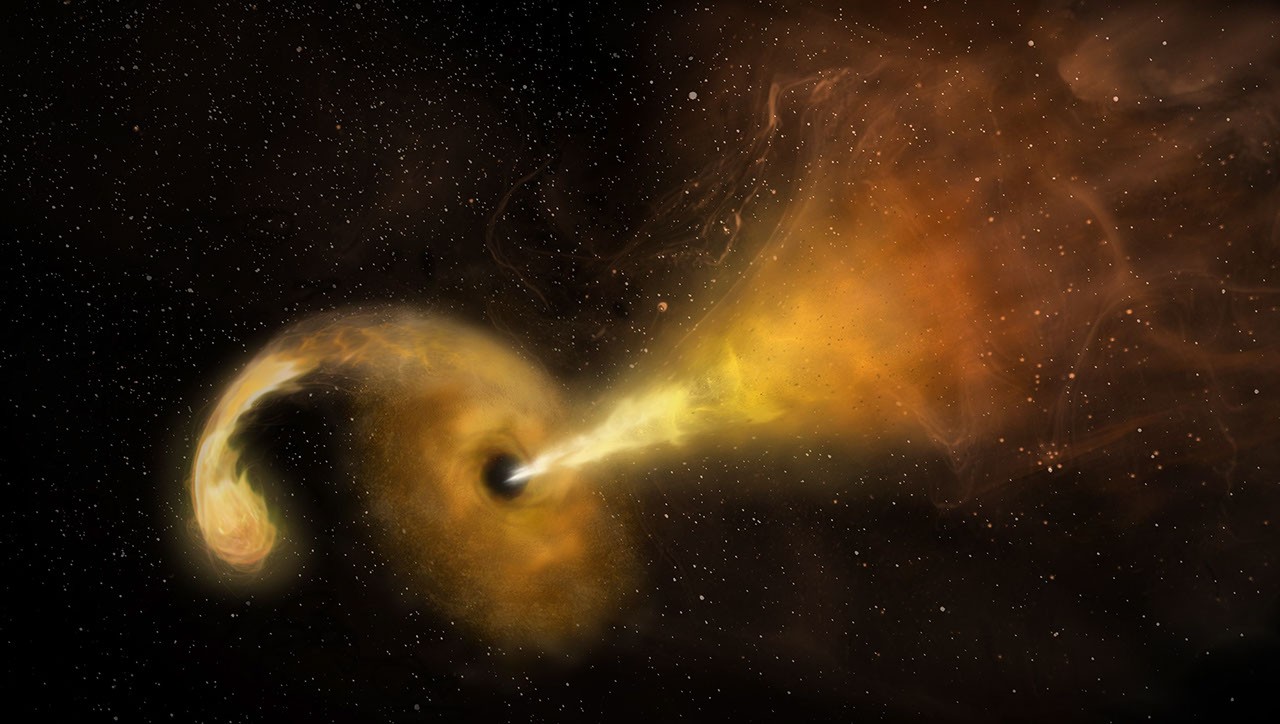
NASA's Neil Gehrels Swift Observatory detected a black hole lighting up as it shredded a star in the outer reaches of a distant galaxy. The orphan—a supermassive black hole ejected from its galactic core—launched a relativistic jet while tidal forces heated crumbs of the splintered star to an observable glow. This marks one of the first confirmed detections of such an event so far outside a galactic center, opening a new avenue to hunt otherwise invisible wandering black holes. (via NASA)
NASA prepares eclipse science campaign. The agency's WB-57 jets will fly at 50,000 feet during August 12's total solar eclipse to capture high-resolution images of the solar corona and study the sun's outer atmosphere. Separate NASA-supported student balloon launches in Iceland and Spain will probe atmospheric changes before, during, and after the eclipse, feeding crucial data on solar heating and atmospheric dynamics. (via NASA)
Curiosity's wheels bear scars of Martian terrain. After 14 years exploring Mars, NASA's Curiosity rover inspected damage accumulated on its wheels during a July 23 observation, revealing fresh holes from sharp rocks and rough patches the rover has crossed. Despite visible wear from over 32 kilometers of driving across mixed terrain, Curiosity's wheels retain enough integrity to continue operations searching for signs of ancient microbial life. (via Space.com)
Research and discovery
Light sculpts exotic quantum matter and heat finds new pathways through crystals
Physicists achieved two breakthroughs this week: creating and observing a light-induced topological state, and watching heat travel in focused waves at room temperature.

Researchers have captured the first direct experimental evidence of a Floquet topological state, a light-induced quantum phase that existed only in theory until now. Using femtosecond laser pulses on tin telluride, physicists observed the material transform from semiconductor to metal without changing its atomic structure, revealing a distinctive Dirac cone signature of topological behavior that vanished within 100 femtoseconds after the pulse. The breakthrough paves the way toward practical quantum computing and spintronics applications controlled by light. (via Phys.org)
Heat travels in focused beams through crystals at room temperature. UCLA engineers demonstrated that phonons—quantum vibrations carrying heat—can move in guided, ray-like patterns through boron arsenide at ordinary room temperatures, a phenomenon previously observed only at near-absolute-zero. The discovery reshapes thermal management by enabling heat to be guided and focused with nanoscale precision, critical for semiconductors and quantum devices where overheating limits performance and reliability. (via Phys.org)
Environmental bacteria act as gene ferries, sparking 10,000-fold antibiotic resistance. Researchers studying cystic fibrosis patients found that antibiotic resistance in lung pathogens spiked dramatically without detectable chromosomal mutations. Environmental bacteria transiently appeared in lungs before resistance emerged, carrying plasmids encoding resistance genes that transferred to established pathogens, causing resistance to jump over 10,000-fold almost instantly. The finding reveals a hidden mechanism allowing bacteria to acquire protective genes beyond traditional mutation pathways. (via Phys.org)
Industry and policy
Amazon pursues direct-to-device satellites while Intel enters space computing market
Major technology companies escalate efforts to capture the commercial space economy with new satellite constellations and specialized hardware.

Amazon filed an FCC application late July 24 for Project Kuiper, a constellation of 5,105 low-Earth-orbit satellites providing direct-to-device voice, data, and messaging services to smartphones and IoT devices. The filing specifies deployment starting in 2028 using 1.6 and 2.4 gigahertz spectrum bands partnered with Globalstar, though Amazon loses temporary priority in that spectrum following the Globalstar acquisition closing in 2027. The direct-to-device market targets Apple's iMessage via satellite and other emergency services on phones without cellular coverage. (via SpaceNews)
Intel debuts Starfire chip engineered for orbital computing. The chipmaker unveiled its first space-grade System-on-Chip, code-named Starfire, featuring four performance cores and four efficiency cores alongside a three-tile neural processing unit delivering up to 75 TOPS of AI computing. Intel plans to ship Starfire samples to space customers in Q3 2026, targeting satellites, spacecraft, and extreme-environment equipment where low power consumption, high reliability, and AI capabilities are paramount. The move marks Intel's formal entry into the dedicated space computing market. (via SpaceNews)
Health and biology
CRISPR tool makes immune-cold prostate tumors visible to therapy
Researchers used RNA-targeting CRISPR to restore immune markers on cancer cells, dramatically boosting checkpoint therapy efficacy in mice.

Scientists developed a Cas13 CRISPR system that transforms prostate cancer from immune-cold to immune-hot by restoring the MHC-1 recognition complex that allows T cells to spot and attack tumors. Prostate cancer cells suppress MHC-1 by shortening mRNA transcripts for the SPSB1 protein, hiding them from immune detection. The CRISPR tool preserves normal transcript length, reducing SPSB1 production and reinstating the cellular flag that T cells use to identify cancerous cells. When combined with checkpoint therapy, the approach dramatically increased T cell infiltration and tumor destruction in mice with no detectable off-target effects. (via ScienceDaily)
Climate and earth
Brown tree snakes conquered Guam despite extreme inbreeding with hidden genetic advantages
A new study reveals that invasive snake populations harbor far more genetic diversity than expected, reshaping understanding of how invasive species adapt and thrive.
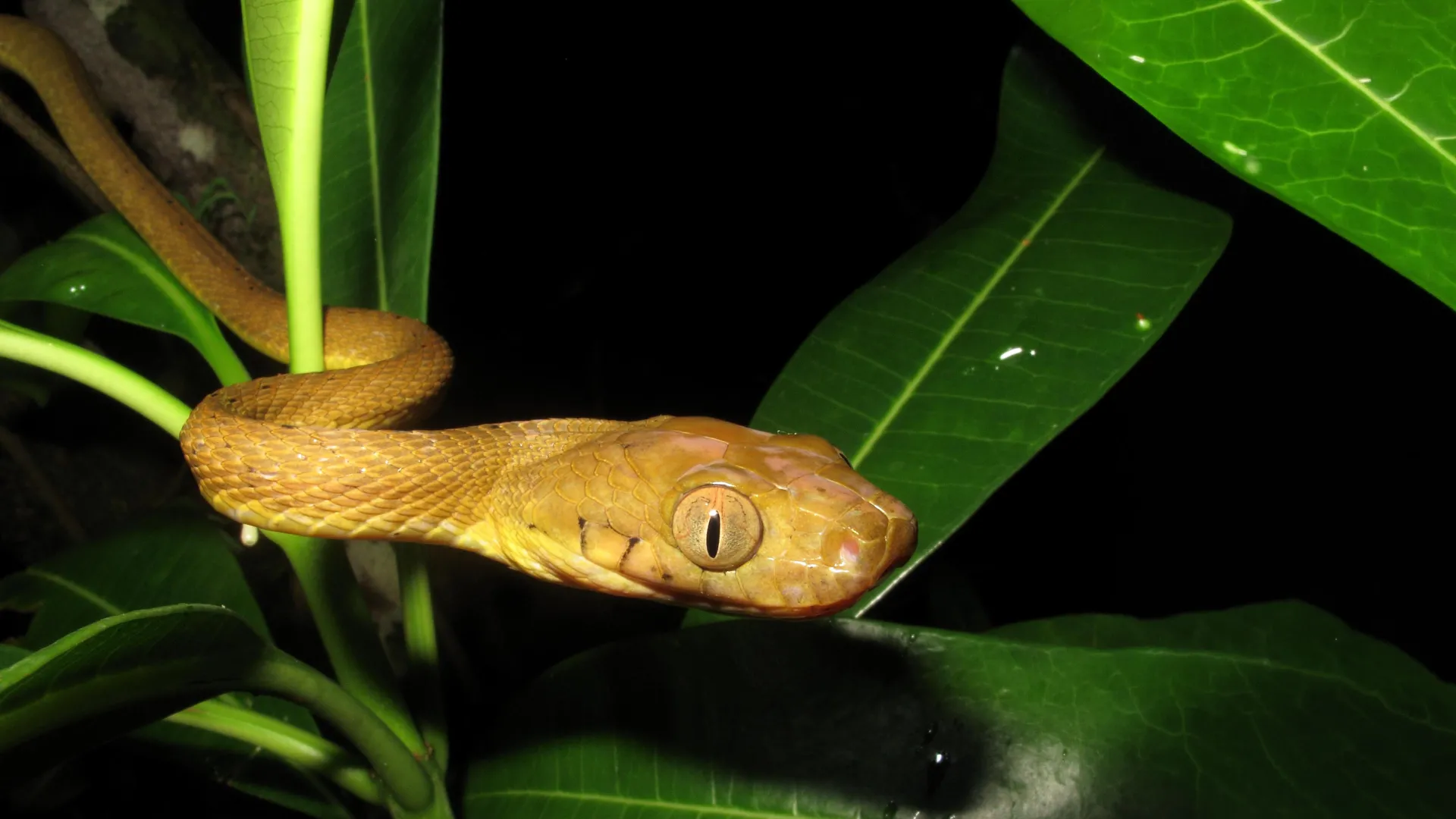
Researchers uncovered why brown tree snakes that devastated Guam's native birds succeeded despite population-level inbreeding that should have crippled them. Using long-read DNA sequencing, scientists discovered over 19,000 large genetic variations—duplications, deletions, and rearrangements—embedded in the snakes' genomes. Notably, these variations cluster in genes governing immunity and olfaction, giving the founding population substantial functional diversity despite severe genetic bottlenecks. The unexpected genetic richness likely enabled rapid adaptation to Guam's environment and explains how a handful of invaders multiplied to extraordinary densities after reaching the island, probably via military cargo after World War II. (via ScienceDaily)